

The global IT industry has been witnessing major disruptions in recent months. One of the biggest headlines has been the large-scale layoffs announced by Oracle Corporation in 2026.Oracle Layoffs
Thousands of employees reportedly lost their jobs, raising serious concerns across the technology sector. This development has sparked discussions about the future of employment in IT, the growing impact of Artificial Intelligence (AI), and how companies are restructuring for the next phase of technological transformation.
About Oracle and Why It Matters
Oracle Corporation is one of the world’s leading technology companies, known for its:
- Database management systems
- Cloud infrastructure services
- Enterprise software solutions
- Business automation platforms
Many Fortune 500 companies, governments, and enterprises rely heavily on Oracle’s technologies.
However, as the technology landscape evolves rapidly, Oracle is also being forced to adapt its business strategy.
What Happened? Overview of Oracle Layoffs in 2026
In early 2026, Oracle reportedly initiated workforce reductions across multiple regions.
According to various industry reports:
- Thousands of employees were affected
- Estimates suggest the number could approach 10,000 globally
- Multiple business units were impacted
- Layoff notifications were reportedly sent through internal emails
- In some cases, employee system access was immediately revoked
The speed and scale of these layoffs shocked many professionals in the global tech community.
Which Employees Were Affected?
The layoffs were not limited to one department.
The affected roles reportedly included:
1. Software Engineers
Developers working on legacy systems and non-core products were among those impacted.
2. Cloud Infrastructure Teams
Certain restructuring efforts affected cloud-related technical positions.
3. Sales and Marketing Professionals
Business restructuring often leads to optimization of go-to-market teams.
4. Project and Program Managers
Management roles were also reduced as part of organizational restructuring.
5. Support and Operations Staff
Automation and AI-based systems are replacing several routine operational tasks.
This indicates that Oracle’s decision was not just cost-cutting—it reflects a broader strategic transformation.
Major Reasons Behind Oracle’s Layoffs
1. Heavy Investment in Artificial Intelligence
Oracle is aggressively investing in:
- AI-driven cloud solutions
- Machine learning infrastructure
- Automated enterprise services
- AI-powered database optimization
This requires significant capital and often leads to internal workforce reallocation.
2. Expansion of Cloud Business
Cloud computing remains one of Oracle’s highest-priority growth areas.
The company is investing heavily in:
- New data centers
- High-performance cloud infrastructure
- Enterprise AI cloud platforms
To fund this expansion, operational restructuring becomes necessary.
3. Cost Optimization
Like many major tech firms, Oracle is focusing on:
- Reducing operational expenses
- Eliminating redundant roles
- Improving profit margins
- Increasing efficiency
Layoffs are often one of the toughest tools companies use for this purpose.
4. Rising Automation
AI and automation are replacing repetitive tasks across industries.
Activities such as:
- Routine monitoring
- Data processing
- Technical support workflows
- Internal reporting systems
are increasingly being handled by automated systems.
Impact on India
India is a key market for Oracle, with major offices in:
- Pune
- Bengaluru
- Hyderabad
Since the layoffs were global, Indian teams may also have been affected.
However, Oracle has not officially disclosed exact India-specific numbers.
For Indian IT professionals, this serves as an important reminder that global technology shifts directly impact local job markets.
What This Means for the IT Industry
Oracle’s layoffs are not an isolated event.
Several major technology companies are adopting similar strategies as they shift toward AI-first business models.
Key industry trends include:
- Rapid adoption of Artificial Intelligence
- Increased cloud transformation
- Decline in traditional support roles
- Greater demand for advanced technical skills
- Organizational restructuring for efficiency
The IT job market is clearly evolving.
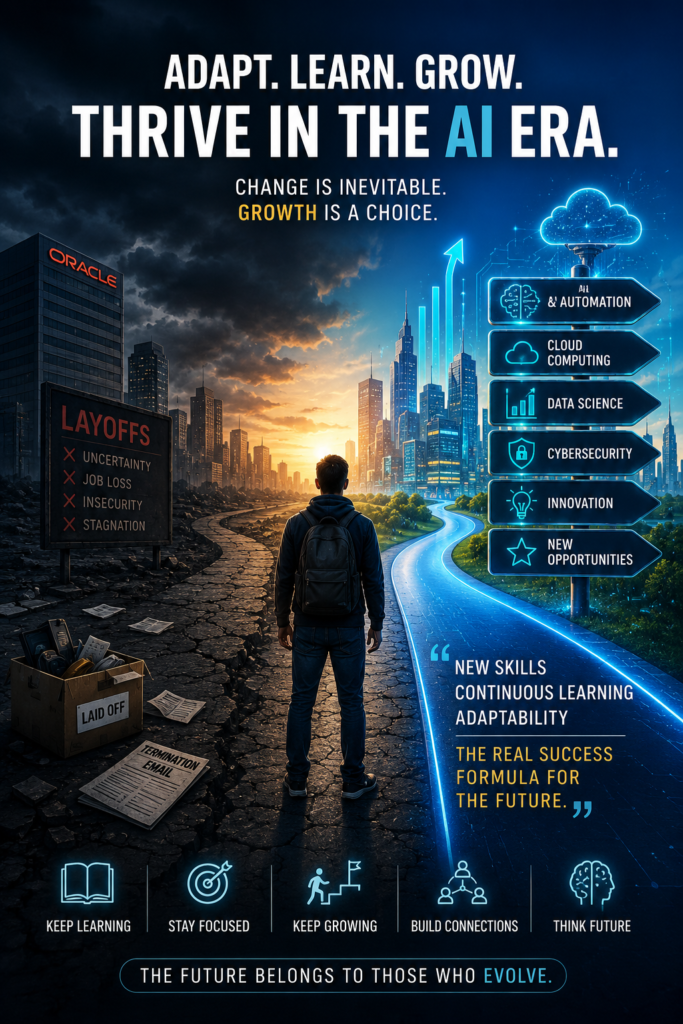
Future Opportunities in the AI Era
Despite layoffs, new opportunities are emerging.
High-demand fields include:
AI Engineering
Building intelligent systems and automation tools.
Data Science
Extracting insights from large-scale enterprise data.
Cloud Engineering
Designing and managing scalable cloud infrastructure.
DevOps and Automation
Improving deployment pipelines and operational efficiency.
Cybersecurity
Protecting increasingly complex digital ecosystems.
Important Lessons for IT Professionals
To stay relevant in 2026 and beyond, professionals should focus on:
Continuous Learning
Technology evolves rapidly. Constant upskilling is essential.
Multi-Skilling
Combine software development with:
- Cloud computing
- DevOps
- AI tools
- Data engineering
Adaptability
Professionals must be ready to shift roles as industries change.
Networking and Career Planning
Strong professional connections create new opportunities.
Final Thoughts
The layoffs at Oracle Corporation reflect a much larger transformation happening across the global technology industry.
The rise of AI and cloud computing is fundamentally changing how companies operate and what skills they need.
For professionals, the message is clear:
Learn continuously, adapt quickly, and embrace change.
In the AI era, those who evolve with technology will build the strongest careers.
New skills, lifelong learning, and adaptability are the real success formula for the future of IT.
Also Read This-How to Start an AI Blog and Make Money in 2026
1 thought on “Oracle Layoffs 2026: Reasons, Impact, and the Future of IT Jobs in the AI Era”