
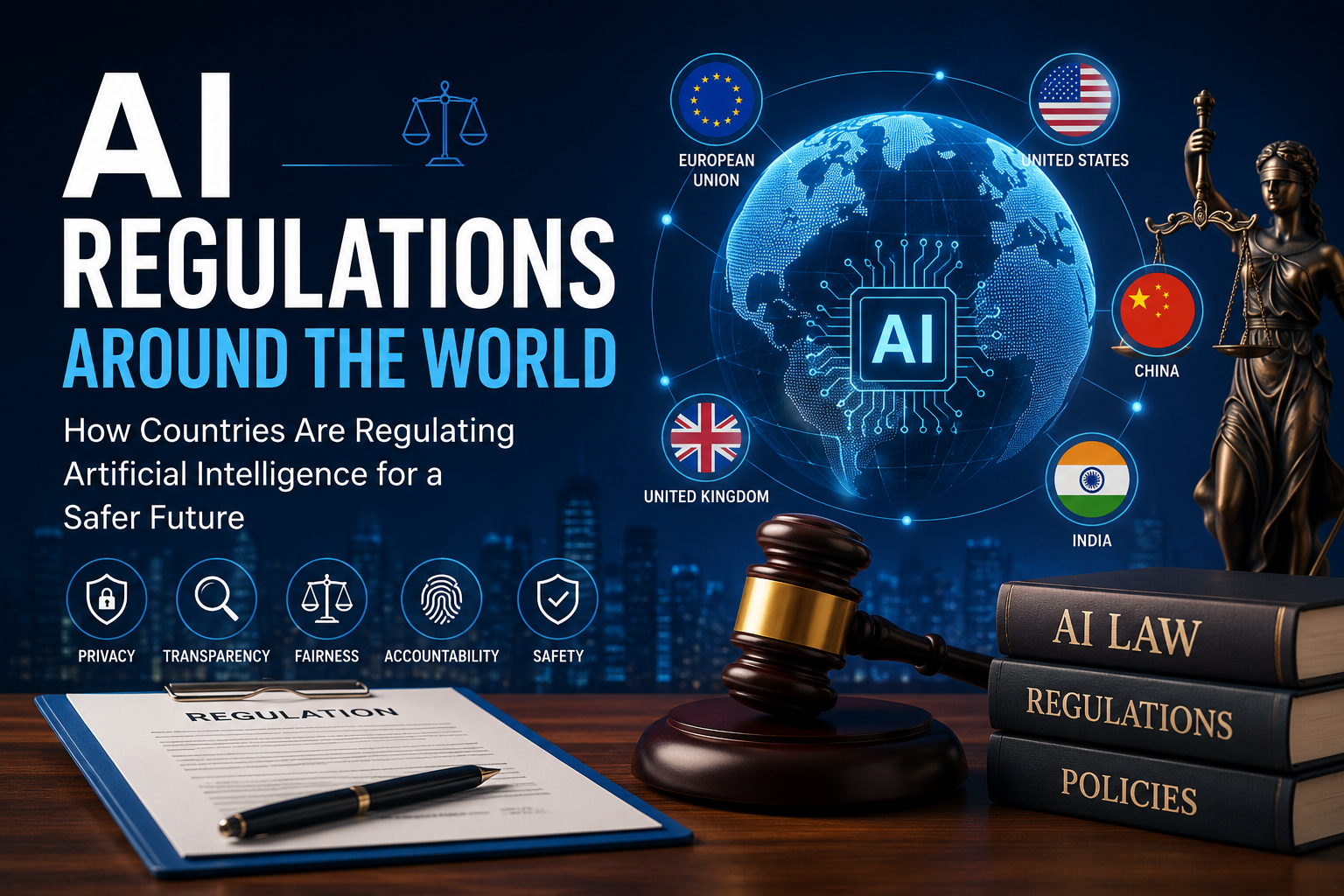
Artificial Intelligence (AI) is growing rapidly across the world.AI Regulations Around the World
From chatbots and self-driving cars to healthcare and education, AI is transforming industries.AI Regulations Around the World But with this rapid growth comes serious concerns about privacy, misinformation, job loss, bias, and security.
To control these risks, many countries have started creating AI regulations. These laws are designed to ensure AI is used safely, ethically, and responsibly.
In this blog, let’s explore how different countries are regulating AI in 2026.
What Are AI Regulations?
AI regulations are laws, rules, and guidelines created by governments to control how Artificial Intelligence is developed and used.
These regulations focus on:
- Data privacy
- Transparency
- AI safety
- Preventing bias
- Accountability
- Preventing misuse
The goal is to balance innovation with public safety.
Why Are AI Regulations Important?
Without regulation, AI can create problems such as:
- Deepfake misinformation
- Privacy violations
- Job displacement
- Algorithmic discrimination
- Cybersecurity threats
- Lack of accountability
That’s why governments worldwide are taking action.
AI Regulations by Country
1. European Union (EU)
The European Union introduced the world’s first major AI law: the AI Act.
Key rules:
- AI systems are classified by risk level
- High-risk AI faces strict rules
- Bans certain dangerous AI uses
- Requires transparency for AI-generated content
The EU focuses heavily on ethical AI development.
2. United States
The United States is taking a flexible approach.
Current focus:
- AI safety guidelines
- Executive orders on AI
- Encouraging innovation
- Regulation of high-risk sectors like healthcare and finance
Also Read This-Best AI Courses in 2026 – Top Online AI Certifications for Beginners
Major companies like
OpenAI,
Google AI, and
Microsoft AI
are working closely with policymakers.
3. China
China has strict AI regulations.
Main focus:
- Government oversight
- Content control
- AI algorithm registration
- Regulation of generative AI systems
China prioritizes national security and social stability.
4. India
India is building its AI regulatory framework.
India’s approach includes:
- Responsible AI guidelines
- Data protection laws
- Promoting AI innovation
- Ethical use of AI in governance
India aims to become a global AI leader while ensuring safe usage.
5. United Kingdom
The UK supports innovation-friendly AI regulation.
Their strategy:
- Sector-specific regulation
- AI principles for fairness and safety
- Encouraging AI startups
The UK focuses on practical governance rather than strict universal laws.
Major Challenges in AI Regulation
Countries face several challenges:
| Challenge | Explanation |
|---|---|
| Fast AI Growth | Laws struggle to keep pace |
| Global Differences | Every country has different rules |
| Enforcement Issues | Difficult to monitor AI systems |
| Innovation vs Control | Too much regulation may slow progress |
The Future of AI Regulations
Experts predict that by 2030:
- More countries will create AI laws
- Global AI standards may emerge
- AI transparency will become mandatory
- Companies will face stricter compliance rules
AI regulation will become as important as internet regulation.
Final Thoughts
AI is one of the most powerful technologies of our time. Proper regulations are essential to ensure AI benefits society without causing harm.
As countries continue developing laws, the future of AI will depend on how well innovation and responsibility are balanced.
AI regulation is not about stopping progress — it is about guiding it safely.
AI Regulations Around the World
AI Regulations Around the World
Artificial Intelligence is growing fast, and many countries are creating rules to control its use. These AI regulations help ensure safety, privacy, transparency, and ethical use of AI technology.
The European Union has introduced strict AI laws through the AI Act. The United States focuses on flexible guidelines and innovation. China has strict controls over AI content and systems. India is developing responsible AI policies, while the United Kingdom supports innovation-friendly AI governance.
AI regulations are important because they help prevent misuse, protect user data, reduce bias, and make AI systems more trustworthy.
As AI continues to advance, more countries are expected to create stronger laws to balance innovation with safety.
AI regulation is shaping the future of technology worldwide.