
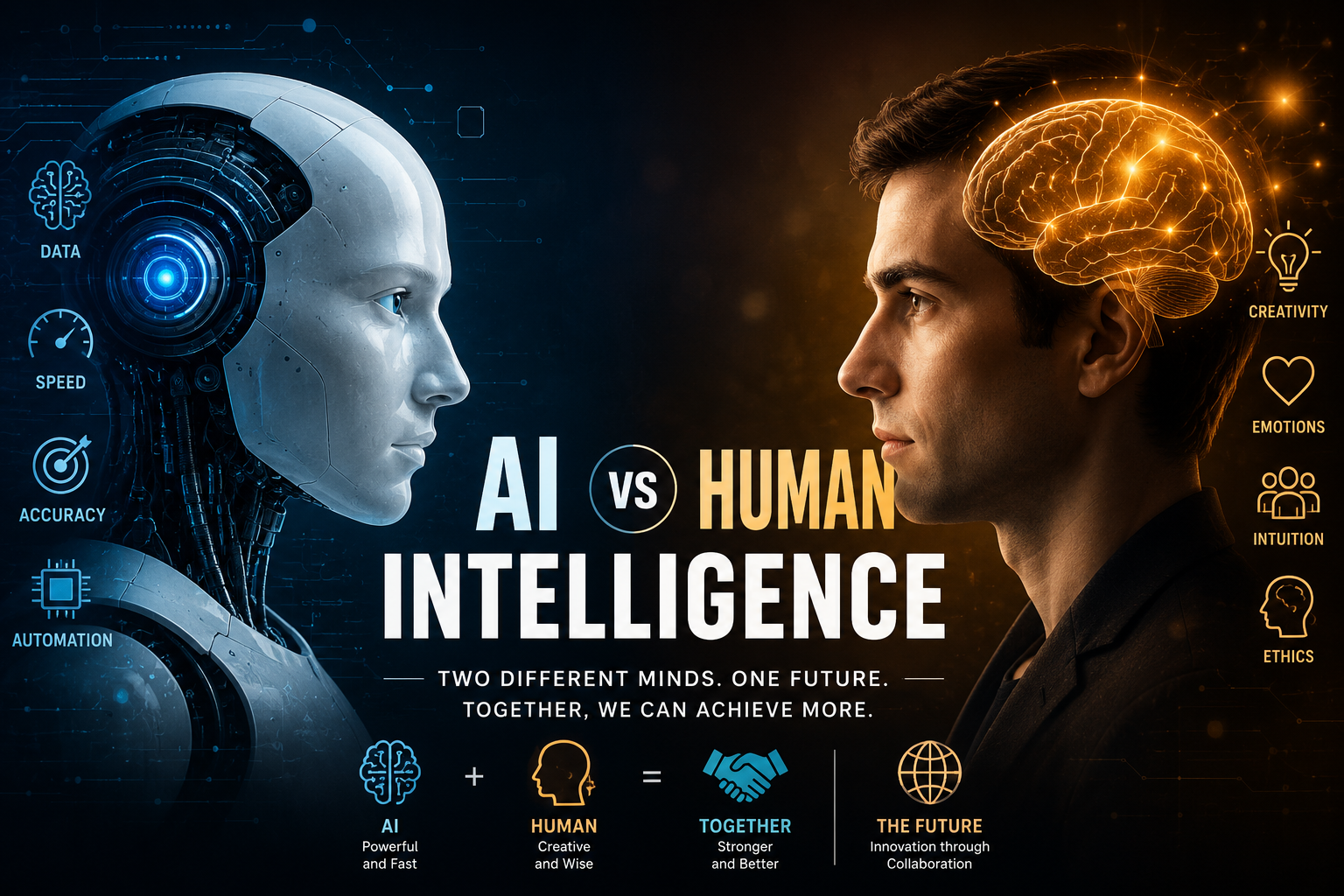
Artificial Intelligence is transforming the world, but many people still ask: Can AI replace human intelligence? AI vs Human Intelligence
The answer is simple — AI is powerful, but it is very different from human intelligence.
While AI can process huge amounts of data quickly, humans have creativity, emotions, common sense, and deep understanding that machines cannot fully copy.
AI vs Human Intelligence — Examples in Detail
1. Problem Solving Example
AI Example
Artificial Intelligence can solve a math problem instantly.
Example:
If you ask AI:
“Solve 3456 × 789”
AI calculates it in seconds with high speed and accuracy.
Human Example
A human can also solve it, but it takes more time.
However, a human can understand why the method works and can explain it in different ways.
Difference:
- AI = Fast calculation
- Human = Understanding logic
2. Creativity Example
AI Example
AI can generate:
- Blog articles
- Images
- Music
- Videos
Example:
OpenAI tools can create blog content from prompts.
Human Example
A writer creates an original emotional story from personal experiences.
Difference:
AI copies patterns from data.
Humans create truly original ideas.
3. Decision Making Example
AI Example
Banks use AI to check loan eligibility by analyzing:
- Credit score
- Income
- Past transactions
AI gives fast decisions.
Human Example
A bank manager may also consider:
- Personal circumstances
- Future potential
- Special situations
Difference:
AI uses data rules.
Humans use judgment.
4. Learning Example
AI Example
AI learns from huge datasets.
Example:
If trained on millions of images, AI can identify a cat.
Human Example
A child can see just a few cats and understand what a cat is forever.
Difference:
AI needs massive data.
Humans learn with fewer examples.
5. Emotion Example
AI Example
AI can detect emotion from text like:
“I am sad today.”
It responds based on programmed patterns.
Human Example
A friend understands:
- Tone of voice
- Facial expression
- Emotional pain
and gives real empathy.
Difference:
AI simulates emotion.
Humans feel emotion.
6. Adaptability Example
AI Example
A chess AI is excellent at chess but cannot cook food.
Human Example
A person can:
- Play chess
- Cook food
- Learn driving
- Solve unexpected problems
Difference:
AI is task-specific.
Humans are flexible.
Real-Life Comparison Table
| Situation | AI Performance | Human Performance |
|---|---|---|
| Data analysis | Excellent | Good |
| Creativity | Limited | Excellent |
| Emotional support | Weak | Excellent |
| Speed | Very fast | Moderate |
| Ethics | No understanding | Strong |
| Innovation | Pattern-based | Original |
Best Real-Life Example
Think of Google Maps.
Google AI can:
- Find shortest route
- Analyze traffic
- Predict arrival time
But a human driver can decide:
- Road looks unsafe
- Weather is bad
- Better local shortcut exists
This shows:
AI provides data
Humans provide wisdom
Final Example (Doctor vs AI)
AI can scan thousands of medical reports quickly.
A doctor can:
- Understand patient fear
- Explain treatment
- Make ethical decisions
So the future is:
AI + Human Intelligence = Better Results
Conclusion
AI is excellent for speed and automation.
Human intelligence is superior in creativity, emotions, ethics, and deep understanding.
Also Read This-Best AI Tools for Excel
AI vs Human Intelligence
Here is a simple comparison between OpenAI’s ChatGPT, Google Gemini, and Human Intelligence.
| Feature | ChatGPT | Gemini | Human |
|---|---|---|---|
| Speed | Very Fast | Very Fast | Slower |
| Data Processing | Excellent | Excellent | Limited |
| Creativity | High | High | Natural & Original |
| Emotional Understanding | Simulated | Simulated | Real |
| Common Sense | Limited | Limited | Strong |
| Learning Method | Training Data | Training Data | Experience |
| Decision Making | Pattern-based | Pattern-based | Logical + Emotional |
| Adaptability | Task-specific | Task-specific | Highly Flexible |