
In today’s digital era, the term Artificial Intelligence (AI) has become a part of our daily lives. From smart alarms to personalized recommendations on YouTube, AI is everywhere. What is AI Technology?
How does it work?
What is Generative AI?
And what opportunities does it create for the future?
What is AI Technology?
If you want to learn AI technology in simple language, this guide will help you understand everything in detail.
AI is Not Just a Machine — It is Intelligence
Imagine your daily routine.
When your smartphone unlocks using face recognition, when Google Maps suggests the fastest route, or when streaming platforms recommend movies based on your preferences — AI is working behind the scenes.
Simply put:
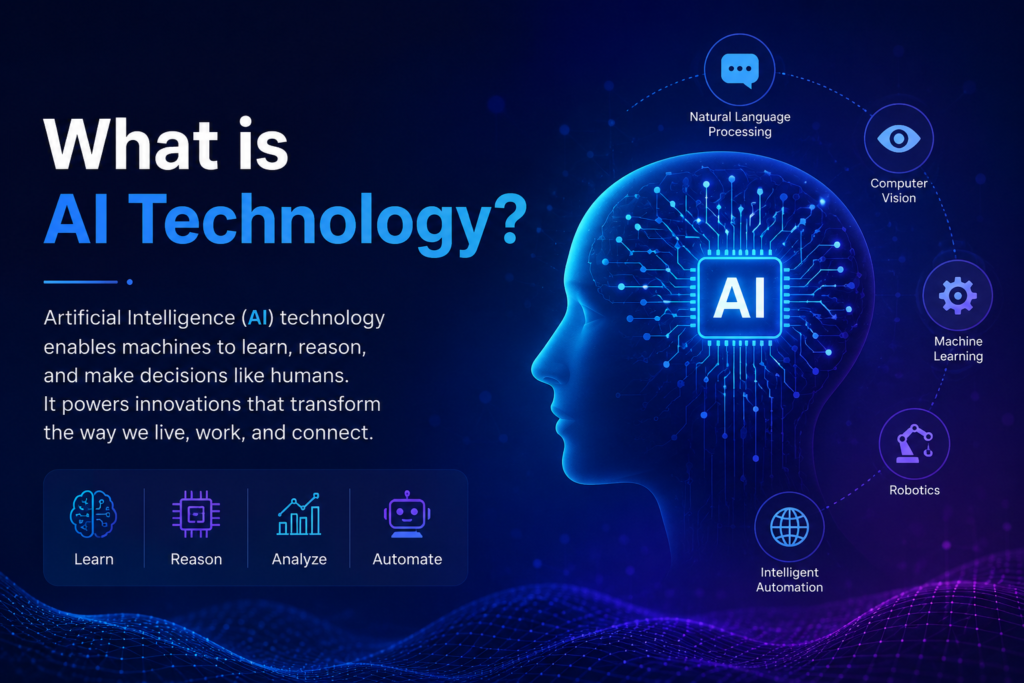
Artificial Intelligence is the ability of machines to think, learn, analyze, and make decisions like humans.
It allows computers to solve problems, process information, and improve over time.
What is AI Technology?
AI technology refers to systems designed to mimic human intelligence.
These systems can:
- Analyze huge amounts of data
- Identify patterns
- Learn from mistakes
- Make predictions
- Generate creative outputs
The main goal of AI is to create machines that can perform tasks requiring human intelligence.
What is AI Technology?
How Does AI Work?
AI works through three major steps.
1. Data Processing
AI collects and analyzes large volumes of information.
Example:
A recommendation system studies your viewing history.
2. Pattern Recognition
AI identifies hidden relationships in data.
Example:
Face recognition detects unique facial patterns.
3. Self-Correction
AI learns from mistakes and improves over time.
This process is called Machine Learning.
Types of Artificial Intelligence
AI can be divided into three major categories.
1. Narrow AI (Weak AI)
This is the AI we use today.
It is designed for specific tasks.
Examples:
- Apple Siri
- Amazon Alexa
- Search engines
Capabilities:
Limited but highly efficient.
2. General AI (AGI)
Artificial General Intelligence would think like humans.
It could:
- Learn any task
- Reason independently
- Solve complex problems
Current Status:
Still under research.
3. Super AI (ASI)
Super AI would surpass human intelligence.
It could:
- Innovate independently
- Learn instantly
- Solve global challenges
This remains a future possibility.
The History of Artificial Intelligence
The journey of AI spans several decades.
1943 – Artificial Neurons
Scientists introduced the first mathematical model of artificial neurons.
This became the foundation of neural networks.
1950 – The Turing Test
Alan Turing proposed a test to measure machine intelligence.
The idea:
If a machine can communicate like a human, it can be considered intelligent.
1956 – Birth of AI
John McCarthy officially introduced the term Artificial Intelligence.
This happened during the Dartmouth Conference.
1997 – AI Defeats Chess Champion
IBM Deep Blue defeated world chess champion Garry Kasparov.
This marked a historic breakthrough.
2022–2026 – The Generative AI Revolution
Modern tools like:
- OpenAI ChatGPT
- Google Gemini
have made AI accessible to everyone.
What is Generative AI?
Generative AI is an advanced type of AI that creates new content.
It can generate:
- Articles
- Images
- Videos
- Music
- Code
Unlike traditional AI, it does not only analyze data.
It creates original outputs.
How Generative AI Works
Generative AI learns patterns from massive datasets.
Then it uses those patterns to generate something new.
What is AI Technology?
For example:
When you ask AI to write a blog, it predicts the best sequence of words based on learned knowledge.
Real-Life Uses of AI Technology
1. Healthcare
AI helps doctors detect diseases faster.
Applications:
- Cancer diagnosis
- Eye disease detection
- Medical imaging analysis
2. Agriculture
AI helps farmers through:
- Weather prediction
- Crop monitoring
- Pest detection
This is highly valuable for farming regions.
3. E-Commerce
AI recommends products based on customer behavior.
Examples:
Shopping platforms suggest products you are likely to buy.
4. Transportation
AI powers self-driving vehicles.
It helps with:
- Navigation
- Object detection
- Safety monitoring
Future Opportunities in AI
AI is creating massive career opportunities.
Popular AI careers include:
AI Engineer
Builds intelligent systems.
Data Scientist
Analyzes data for insights.
Prompt Engineer
Creates effective AI instructions.
Machine Learning Specialist
Designs systems that learn from data.
AI Content Creator
Uses AI tools for content generation.
Challenges of AI Technology
AI offers many benefits, but also raises challenges.
Data Privacy
Protecting personal information is critical.
Job Transformation
Some traditional jobs may change.
However, new AI-related roles are emerging.
Ethical Concerns
Responsible use of AI is essential.
Can You Learn AI in Simple Language?
Absolutely.
Today, AI learning has become easier than ever.
You can start with tools like:
- OpenAI ChatGPT
- Google Gemini
- Canva Canva AI
Practice regularly and experiment with prompts.
Frequently Asked Questions
Will AI replace humans?
No.
AI will support humans, not replace them completely.
People who learn AI will have greater opportunities.
Is AI difficult to learn?
Not at all.
With regular practice, anyone can learn it.
What is the future of AI?
The future includes smarter automation, Generative AI, and possibly Super AI.
Conclusion
Artificial Intelligence is no longer a futuristic concept.
It is already shaping our world.
From daily convenience to career growth, AI is opening endless possibilities.
The key is not to fear AI but to learn and use it wisely.
AI should become your assistant, not your replacement.
Start learning today, stay updated, and prepare yourself for the future of intelligent technology.
Also Read This-AI in Agriculture: How Artificial Intelligence is Transforming Farming in 2026
1 thought on “What is AI Technology? History, Types, Generative AI, and Future Opportunities Explained”