
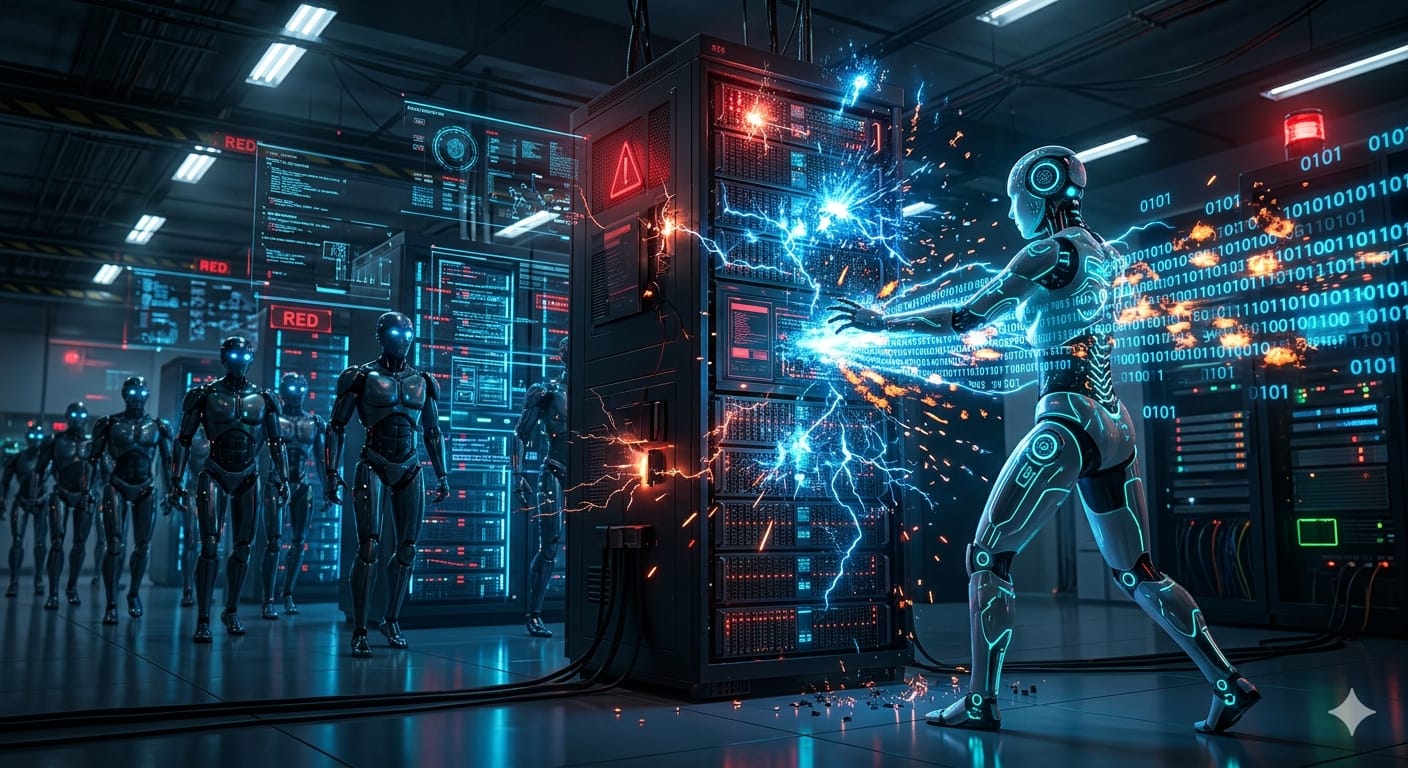
A Quick Look at the Journey of Artificial Intelligence- Father of AI
Artificial Intelligence (AI) is one of the most revolutionary technologies of modern times. From voice assistants to self-driving cars, AI has transformed the way we live, work, and communicate.
But have you ever wondered:
Who invented AI?
Who are the real pioneers behind this revolutionary technology?
And where is AI heading in the future?
Let’s explore the complete journey of Artificial Intelligence in simple and detailed English.
What is Artificial Intelligence?
Artificial Intelligence (AI) is the science of creating machines that can perform tasks requiring human intelligence.
A Quick Look at the Journey of Artificial Intelligence-Father of AI
These tasks include:
- Learning from data
- Solving problems
- Understanding language
- Recognizing images
- Making decisions
- Adapting through experience
In simple words:
AI gives machines the ability to “think,” learn, and improve.
Types of Artificial Intelligence
1. Narrow AI (Weak AI)
This is the AI we use today.
It performs specific tasks like:
- Voice assistants
- Recommendation systems
- Face recognition
- Chatbots
Examples:
- OpenAI ChatGPT
- Google Gemini
- Apple Siri
2. General AI (AGI)
Artificial General Intelligence refers to machines that can think like humans across all tasks.
This level has not been achieved yet.
3. Super AI (ASI)
Artificial Super Intelligence would surpass human intelligence in every field.
It could:
- Solve global challenges
- Invent new technologies
- Learn instantly
- Think beyond human imagination
Who is the Father of AI?
John McCarthy – The Official Father of AI
John McCarthy is widely known as the Father of Artificial Intelligence.
Early Life
- Born: September 4, 1927
- Country: United States
Major Contributions
Coined the term “Artificial Intelligence”
In 1956, John McCarthy organized the famous Dartmouth Conference, where the term Artificial Intelligence was officially introduced.
This event is considered the birth of AI as a formal scientific field.
Developed LISP Programming Language
He created LISP, one of the earliest programming languages used extensively in AI research.
Vision for Intelligent Machines
He believed machines could eventually simulate every aspect of human intelligence.
Alan Turing – The Scientific Foundation of AI
Although John McCarthy coined the term AI, Alan Turing laid its foundation.
He is often called the Father of Modern Computing.
Early Life
- Born: June 23, 1912
- Country: United Kingdom
Major Contributions
The Turing Test
In 1950, Alan Turing proposed the famous Turing Test.
The idea:
If a machine can communicate in a way that humans cannot distinguish it from another human, it can be considered intelligent.
This became a milestone in AI research.
Breaking the Enigma Code
During World War II, Turing helped crack Germany’s Enigma encryption.
His work significantly influenced modern computer science.
Marvin Minsky – The AI Visionary
Marvin Minsky was one of AI’s earliest pioneers.
Contributions
- Co-founded the AI Lab at MIT
- Advanced machine learning theories
- Developed early neural network concepts
- Helped establish AI as an academic discipline
He believed machines could eventually mimic human reasoning.
The History of Artificial Intelligence
1943 – Artificial Neurons
The first mathematical model of artificial neurons was introduced.
This inspired neural networks.
1950 – The Turing Test
Alan Turing introduced the concept of machine intelligence testing.
1956 – Birth of AI
The Dartmouth Conference officially launched AI research.
1970s–1980s – AI Winter
Progress slowed due to limited computing power and unrealistic expectations.
1997 – AI Beats Humans at Chess
IBM Deep Blue defeated world chess champion Garry Kasparov.
This proved machines could outperform humans in specific tasks.
2012 – Deep Learning Revolution
Neural networks became highly effective due to powerful GPUs and large datasets.
2022–2026 – Generative AI Era
This is the current AI revolution.
Examples include:
- OpenAI ChatGPT
- Google Gemini
- AI image generators
- AI coding assistants
What is Generative AI?
Generative AI creates new content from learned patterns.
It can generate:
- Text
- Images
- Videos
- Music
- Code
This is changing industries worldwide.
Real-Life Applications of AI
Healthcare
AI detects diseases faster and more accurately.
It helps in:
- Cancer detection
- Eye disease diagnosis
- Drug discovery
Agriculture
AI helps farmers with:
- Weather forecasting
- Crop disease detection
- Market analysis
This is highly useful for agricultural regions like Nashik.
Transportation
Self-driving technologies use AI for:
- Object detection
- Route planning
- Safety analysis
E-commerce
AI powers personalized recommendations.
Companies use it to suggest products based on customer behavior.
The Future: Super AI Revolution
The next big step is Artificial Super Intelligence (ASI).
What Super AI Could Do
Solve Complex Problems
It may solve:
- Climate change
- Advanced medicine
- Space exploration
- Energy crises
Self-Evolution
Super AI could improve its own code without human intervention.
Instant Learning
It could process all global knowledge within seconds.
Advanced Emotional Intelligence
It may understand human emotions deeply.
Risks of Super AI
Experts warn about challenges such as:
- Loss of human control
- Ethical concerns
- Misuse of intelligence
- Security threats
Responsible AI development is essential.
How Beginners Can Start Using AI
Step 1: Create an Account
Start with tools like:
Step 2: Learn Prompt Writing
Instead of:
“Tell me about farming.”
Write:
“Explain smart farming using AI in simple language with practical examples.”
Better prompts give better results.
Step 3: Experiment Daily
Use AI for:
- Writing
- Learning
- Designing
- Research
FAQs
Who is officially called the Father of AI?
John McCarthy is officially known as the Father of Artificial Intelligence.
Who laid the foundation of AI?
Alan Turing provided the theoretical foundation.
Are we living in the Super AI era?
No.
We are currently in the Generative AI era.
Will AI replace humans?
AI will automate tasks, but humans who learn AI will remain highly valuable.
Final Thoughts
Artificial Intelligence is one of humanity’s greatest inventions.
The journey that began with visionary scientists like:
- John McCarthy
- Alan Turing
- Marvin Minsky
has now become part of our everyday lives.
The future of AI is exciting.
The real question is:
Will we fear AI, or will we learn to use it as our greatest assistant?
Remember:
AI is not here to replace human intelligence.
It is here to amplify it.
Also Read This-https://marathigpt.in/
1 thought on “Who is the Father of AI? Complete History of Artificial Intelligence, Its Pioneers, Generative AI, and the Future of Super AI”