
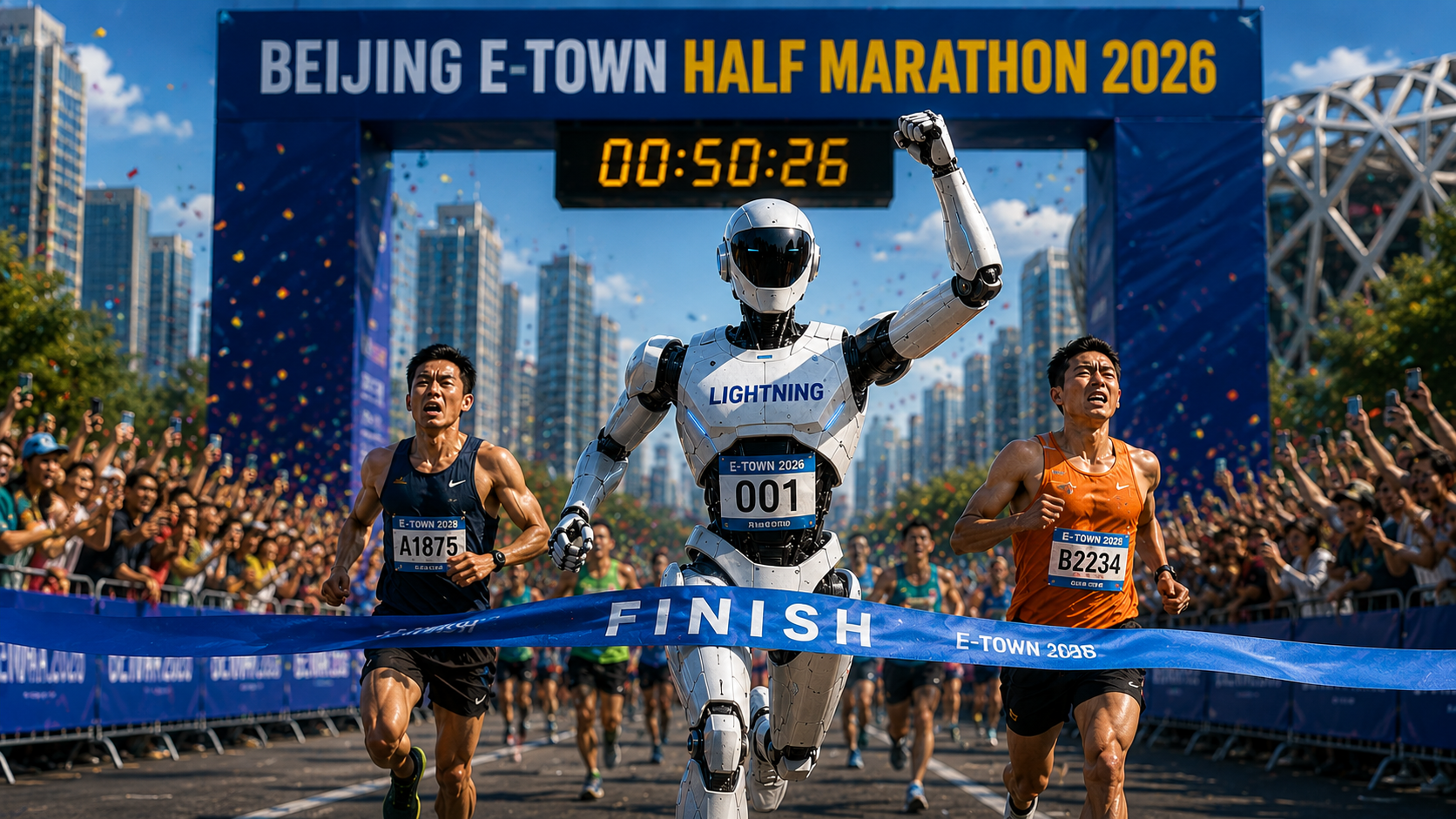
In April 2026, the world witnessed a historic moment that may redefine the future of technology forever. At the famous Beijing E-Town Half Marathon 2026, the spotlight was not only on human runners but also on humanoid robots competing alongside them.
Among all participants, one robot captured global attention — “Lightning,” a humanoid robot developed by Honor. What shocked the world was not just its participation, but its incredible performance. Lightning completed the half marathon in only 50 minutes and 26 seconds, reportedly surpassing human world-record pace and demonstrating how far robotics and artificial intelligence have advanced.
This was more than a race. It was a glimpse into the future of human-machine collaboration.
Humanoid Robots Enter Competitive Sports-
Beijing E-Town Half Marathon
Over the last decade, technologies like Artificial Intelligence (AI), Machine Learning, and Robotics have evolved rapidly. Robots are already being used in industries such as healthcare, manufacturing, defense, agriculture, and education.
However, seeing robots compete in endurance sports like marathon running once seemed possible only in science fiction movies.
That changed dramatically at the Beijing E-Town Half Marathon 2026, where over 100 humanoid robots reportedly participated. Nearly 40% of them operated fully autonomously, meaning they required no direct human control during the race.
These robots could:
- Detect and avoid obstacles
- Maintain balance while running
- Adjust speed automatically
- Navigate routes independently
- Make real-time decisions using AI
The event demonstrated that robots are no longer limited to controlled laboratory environments — they are becoming capable of functioning in dynamic real-world conditions.
“Lightning” — The Robot That Stole the Show
The true star of the marathon was undoubtedly Lightning.
Designed to imitate human movement as naturally as possible, the robot featured:
- Advanced motion sensors
- AI-powered navigation systems
- Real-time balance correction
- Efficient energy management technology
- High-performance robotic joints
What amazed spectators most was how human-like its movements appeared. From a distance, many viewers reportedly struggled to distinguish whether Lightning was a robot or an actual athlete.
Its ability to maintain high speed while consuming minimal energy became one of the biggest technological highlights of the event.
The finishing time of 50 minutes and 26 seconds was not just a speed achievement — it symbolized the incredible progress made in robotic engineering.
From 2025 to 2026: A Massive Leap in Robotics
The difference between humanoid robots in 2025 and 2026 is astonishing.
In 2025, many experimental running robots still faced major limitations:
- Poor balance control
- Limited battery life
- Slow movement speed
- Difficulty handling uneven terrain
- Frequent crashes or shutdowns
But within just one year, robotic capabilities improved dramatically.
The 2026 generation of humanoid robots became:
- Faster
- More stable
- More energy efficient
- Better at understanding surroundings
- Capable of making intelligent real-time decisions
This rapid evolution clearly shows that robotics development is now progressing at an exponential pace rather than a linear one.
How Can Robots Run Faster Than Humans?
Many people wonder how robots are capable of outperforming humans in endurance-based activities.
Here are the major reasons:
1. Robots Do Not Experience Fatigue
Humans get tired. Muscles weaken, breathing becomes heavier, and physical limitations eventually reduce performance.
Robots do not suffer from biological exhaustion in the same way.
2. Precision Movement Calculations
Every robotic step is mathematically optimized.
AI systems continuously calculate:
- Stride angle
- Speed
- Weight distribution
- Balance adjustments
This level of precision is difficult for humans to maintain consistently over long distances.
3. Real-Time Data Processing
Using advanced sensors and onboard processors, robots can analyze surroundings within milliseconds.
This allows them to:
- Avoid obstacles instantly
- Adjust speed dynamically
- Maintain optimal running patterns
4. Improved Battery Technology
Modern energy systems now allow humanoid robots to operate for longer durations without significant power loss.
Battery innovation played a major role in the marathon success of robots like Lightning.
What Does This Mean for Humans?
Robots becoming faster does not mean humans are becoming irrelevant.
Instead, these advancements could create entirely new opportunities.
Healthcare Applications
Humanoid robots could assist elderly people, help in hospitals, and support doctors during emergencies.
Disaster Response
In earthquakes, fires, floods, or dangerous rescue operations, robots could enter environments too risky for humans.
Manufacturing and Industry
Factories may increasingly use humanoid robots for:
- Heavy lifting
- Repetitive tasks
- Hazardous operations
- 24/7 productivity
Sports Science and Research
Studying robotic movement can help scientists better understand human biomechanics, injury prevention, and athletic performance.
Growing Concerns About AI and Robotics
While the technology is impressive, it also raises important questions.
Job Displacement
As robots become more capable, many people worry about automation replacing human jobs.
Industries may increasingly rely on intelligent machines for tasks once handled by workers.
Safety and Control
Autonomous robots making independent decisions also raise concerns:
- What happens if a robot malfunctions?
- Who is responsible for its actions?
- How should intelligent machines be regulated?
These ethical and safety questions are becoming more important as robotics technology advances.
China’s Big Leap in Robotics
The Beijing E-Town event also highlighted another important reality:
China is rapidly becoming a global leader in AI and robotics.
With strong government support, major investments, and collaboration between universities and technology companies, China has accelerated innovation in intelligent machines.
The success of events like this sends a powerful message to the world:
the future of competition may not revolve only around smartphones or software anymore — it may center around intelligent robotic systems.
What Could the Future Look Like?
The future may include:
- Separate Olympic events for robots
- Human-robot sports teams
- AI-powered personal assistants in every home
- Humanoid robots helping with daily tasks
- Smart cities filled with autonomous machines
What feels extraordinary today could become completely normal within the next decade.
Conclusion
The Beijing E-Town Half Marathon 2026 was not just a sporting event — it was a historic technological milestone.
Robots like Lightning proved that AI and robotics are no longer limited to research labs. They are entering the real world, competing alongside humans, and in some cases, even outperforming them.
This technological progress is inspiring, but it also reminds humanity of the importance of responsible innovation.
If developed and managed wisely, humanoid robots may not become humanity’s rivals — they could become our greatest partners.
The future is no longer distant.
It is already running toward us — and its name might just be Lightning.
Also Read This-Benefits of AI in Daily Life
1 thought on “Beijing E-Town Half Marathon 2026: The Day Robots Outran Humans”